

★ 4.9 on Google · 150+ Reviews · Best of 2026 · BPI Certified
AC operation is whether the equipment runs the way a technician expects. It turns on, the refrigerant pressures read normal, the temperature split is 18 to 20 degrees and the parts work.
AC performance is whether the whole system delivers what your building needs. That means the right temperature and humidity in every room, clean air and a reasonable electric bill, under the real conditions of your house, your property and how your family lives in it.
Operation is a technical check. Performance is an HVAC system design evaluation. Almost every AC passes the first one. Many fail the second.
Maybe you’ve had two or three AC companies out. Maybe you brought in an indoor air quality specialist or a mold inspector. Some told you everything looks fine. Some told you “it’s just Florida.” Some found a problem, like high humidity or mold, but couldn’t tell you what’s causing it or how to stop it.
So you started researching on your own, and you found words like static pressure, airflow and humidity control. You started to suspect the answer is bigger than anything you’ve been told.
You’re right. The problem is real, it has a cause, and it can be found. The right evaluation just hasn’t been done yet.
Two or three companies already told you your AC is fine, and your house still isn’t? Call us. We’ll find what they missed.
Think about how medicine works. You go to your general physician and tell him you’ve been having small chest pains. He listens, checks your pulse and blood pressure, and suspects a heart condition. He doesn’t treat it himself. He sends you to a cardiologist.
The cardiologist listens to what you’re experiencing, then runs the tests that find the cause. He doesn’t guess. He gathers the data, compares it to what a healthy heart should be doing, and treats the cause.
Your AC works the same way. An AC technician is like the general check-up. He looks at how the unit operates. When the problem is comfort, humidity, air quality or mold, you need the specialist: someone who evaluates the performance of the whole system inside your building, runs the tests, gathers the data and finds the cause.
That’s the work we do.
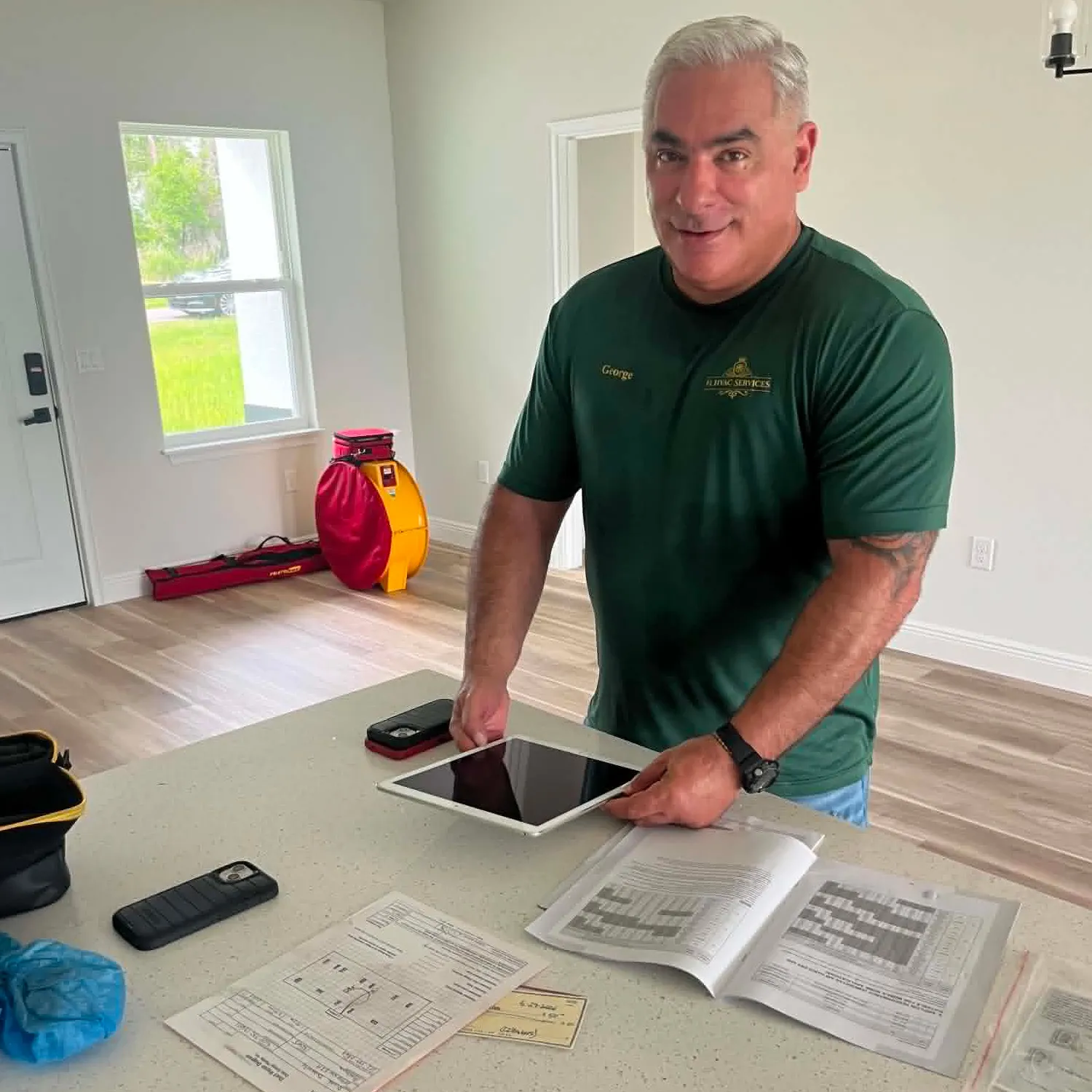
Reviewing a system’s performance test results with the homeowner.
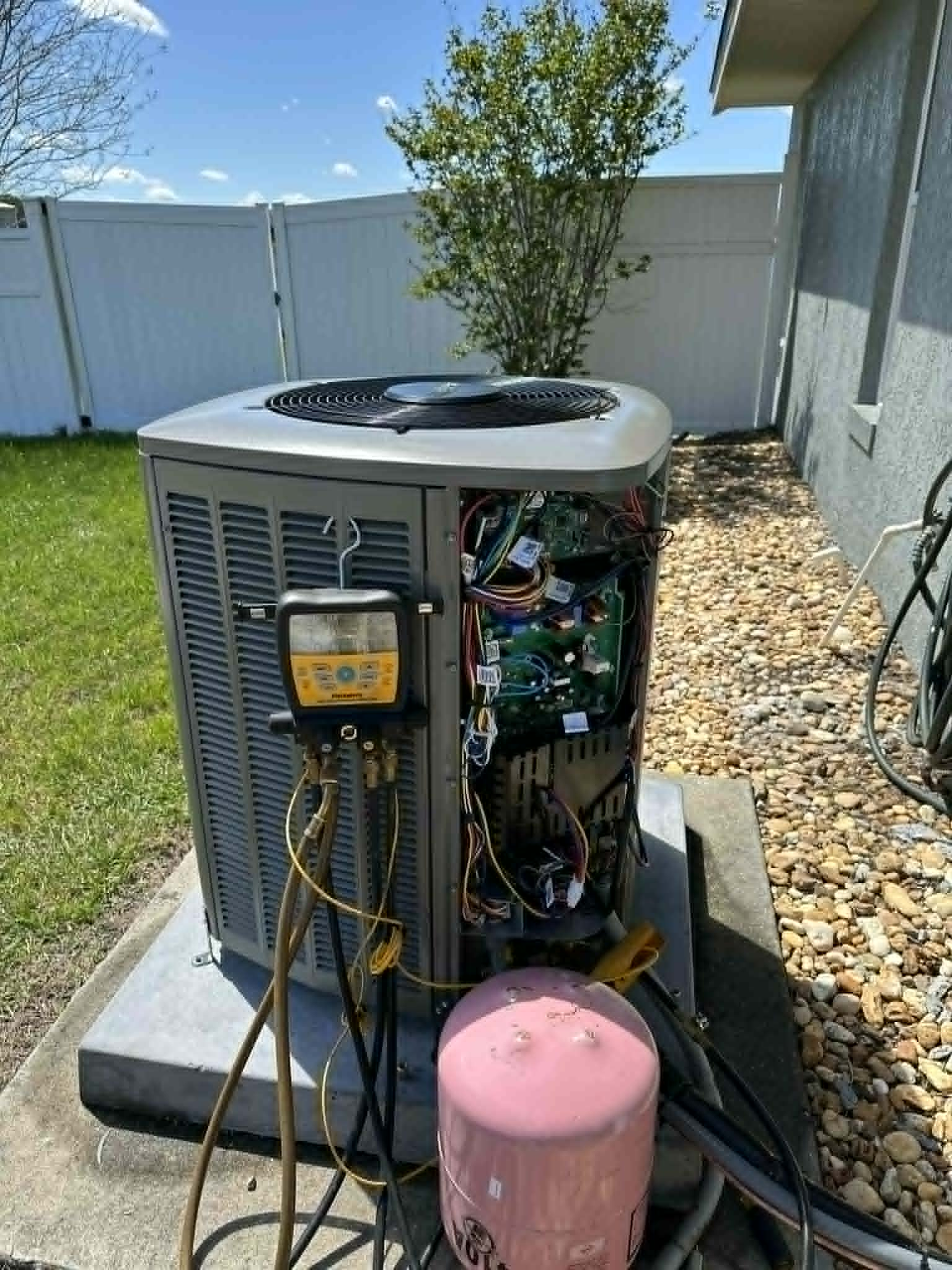
On a typical service call or tune-up, the technician checks the operation of the unit:
These checks matter. They catch a weak capacitor or a low charge. But every one of these readings can come back good on a system that is failing your home every single day. That’s why so many homeowners hear “your system is working fine” while they live in a house that is sticky, uneven, musty and expensive to cool.
A good temperature split tells you one thing: the coil is cooling the air passing over it. That’s all. It doesn’t tell you:
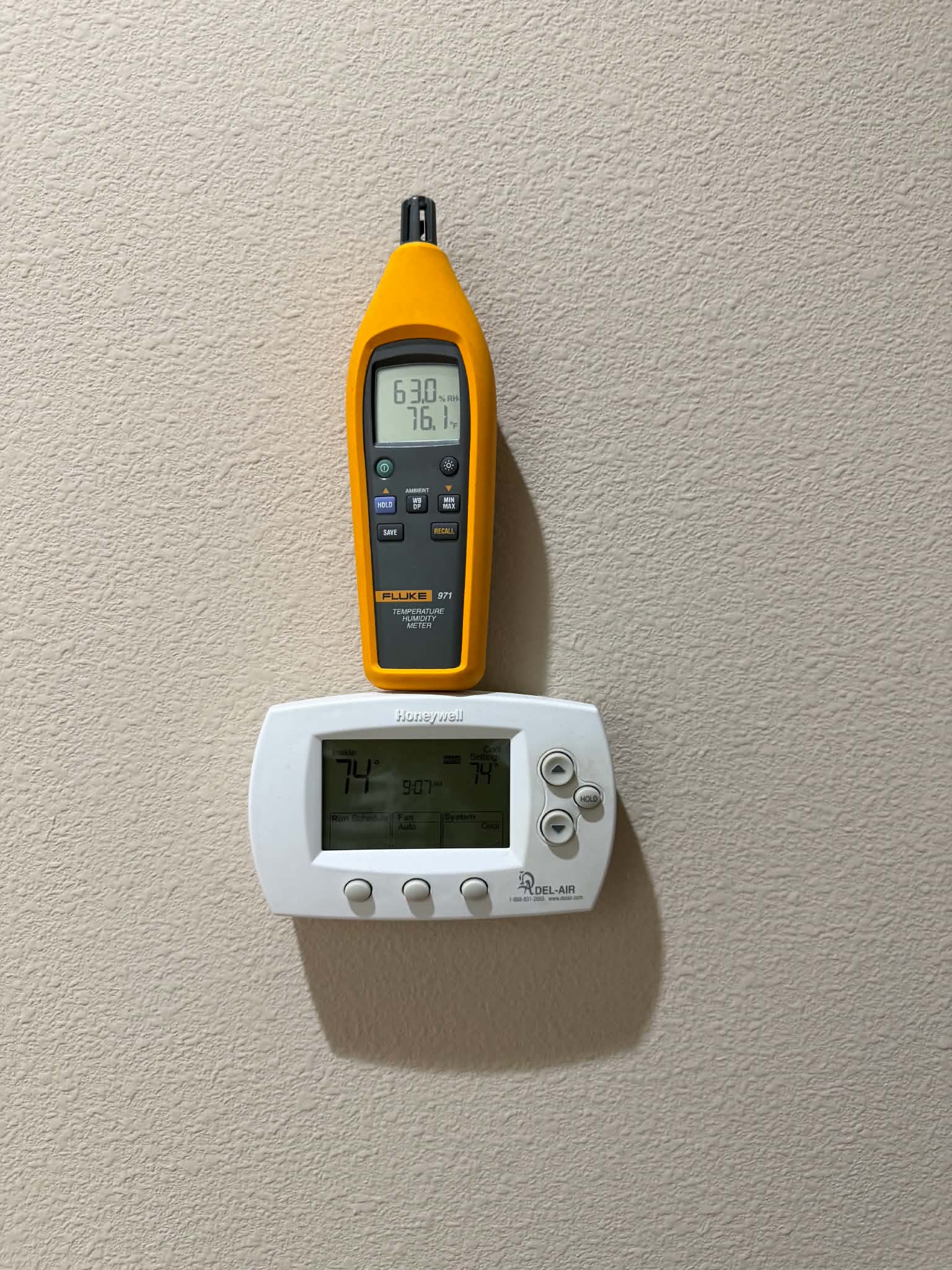
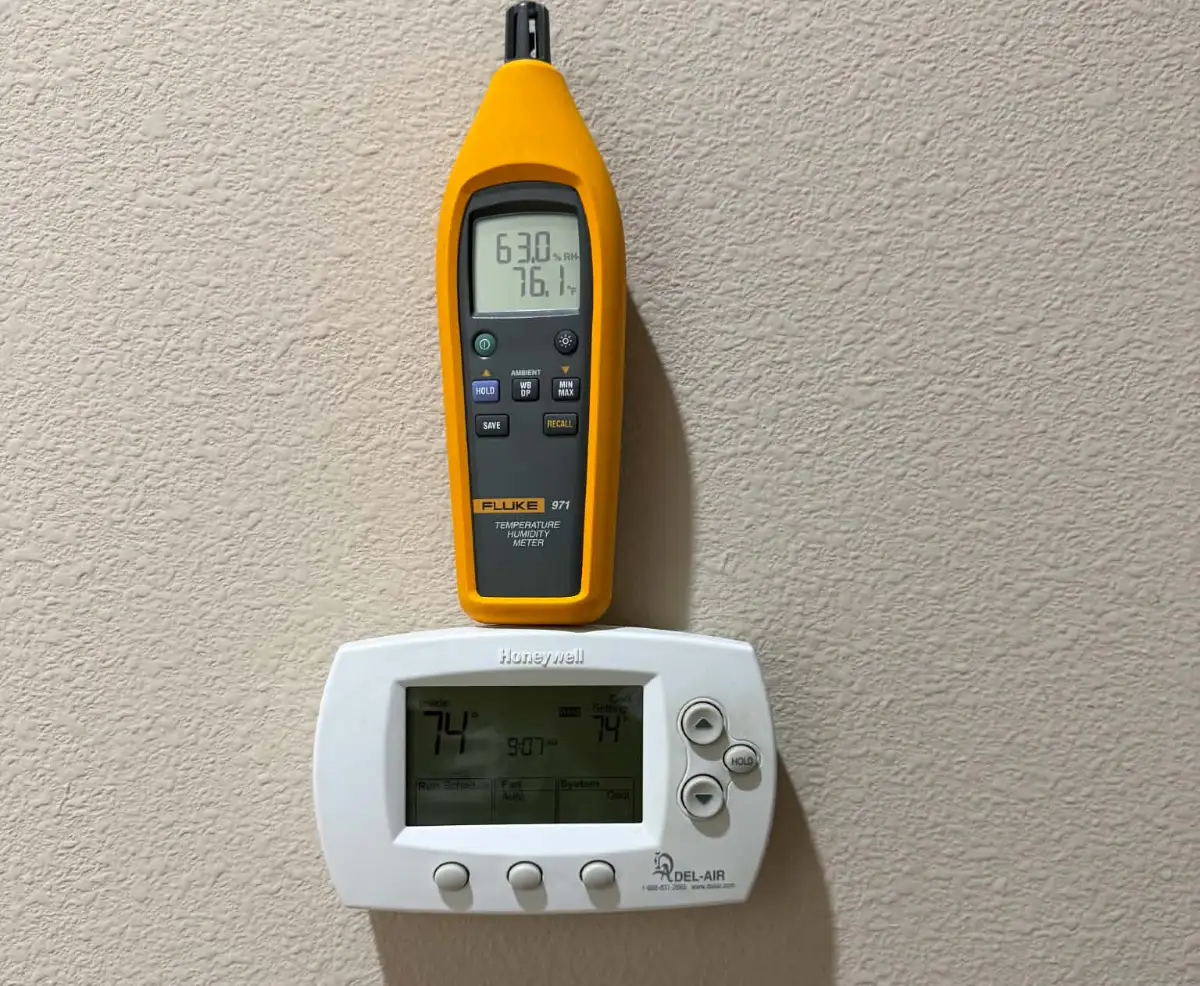
A thermostat set to 74° in a home sitting at 63% humidity. Cool on the thermometer, wet enough to grow mold.
Nearly every AC company we follow behind gets the temperature split right. The homeowner still has 63% humidity, a hot bedroom and a musty smell. The split was never the problem.
Your technician checked the temperature split and called it good? Call us. We’ll measure what the split can’t tell you.
AC technicians go to technical school to learn units: the parts, how they work, how each type of system runs and how to repair it. That’s what they’re trained to do, and many do it well.
They look at the ductwork, but ductwork is a design subject. Technical school doesn’t teach how a building behaves, how much heat and moisture it takes on, or how to select a system that matches it.
There are about 54 manufacturers in this country building roughly 17,000 combinations of outdoor units, indoor units and features. There are that many because there are that many different needs around the world. Florida is hot and humid. Colorado is dry. A home in Idaho may need to add moisture to the air. A Florida home has to remove it most of the year.
The manufacturer has no idea where its equipment will end up. So they build different units with different performance, and it’s up to the designer to know which one matches the house. The building tells the designer what kind of performance it needs. Then the designer searches those combinations to find the system that delivers it.
That’s what AC technicians aren’t trained to do.
See how an AC system should be designed and sized, step by step →
When a technician can’t find the cause, he guesses. And the first thing he blames is the unit. The usual answer is a new unit, and usually a bigger one.
But high humidity and uneven rooms usually have nothing to do with the unit itself. A new unit chosen the same way, without the right match for the building, brings the same problems right back. Often it’s worse, because bigger means more oversized.
Oversizing can be one of the causes. But even an oversized system doesn’t always have to be replaced. A trained designer knows how to make adjustments and design around it. A guess doesn’t.
Think about building a house. You hire an architect to do the design, the drawings and the plans. Those plans go to the contractors in each trade, who build what’s on paper. The architect isn’t a contractor, and the contractor isn’t an architect.
Most AC companies are contractors. They install. They don’t design.
So what happens when something doesn’t work right? The designer blames the installer. The installer blames the design. The manufacturer blames both. It’s a “who’s on first, what’s on second” situation, and you’re stuck in the middle with the problem. Nobody takes responsibility, nobody takes ownership and nobody solves it.
What can you do then? Leave a bad review? Take them to court? Who’s going to prove what’s right and what’s wrong to a judge?
We’re different because we’re both. We’re the designers and the contractors, rolled into one. We evaluate the building, design the solution, do the work, and measure the results to prove it. When we’re responsible for all of it, there’s no one to point at but us, and we put our results in writing.
The installer blames the house, the house blames the AC, and nobody fixes it? We own the problem from the design to the results.
Your AC doesn’t operate in a lab. It operates in your house, and your house changes how your AC behaves.
Insulation, windows, attic ventilation, air leaks and where the ductwork runs all change how much heat and moisture the AC has to remove. Ductwork in a Florida attic sits in some of the hottest, most humid air on your property.
Spray foam lowers the heat load, but it traps humidity inside the house. The temperature drops easily, but the humidity stays high: cool, but damp and musty.
Does a spray foam home need a different AC? Not always. It depends. We test whether the existing system can remove the humidity trapped inside the home, then determine how to balance temperature and humidity for that house.
The land around your house changes your home’s load too: trees shading the entire house, wind blocked by fences, trees and houses built close together, a screened pool enclosure adding moisture next to the house, and glass that condenses because the air is hitting its dew point.
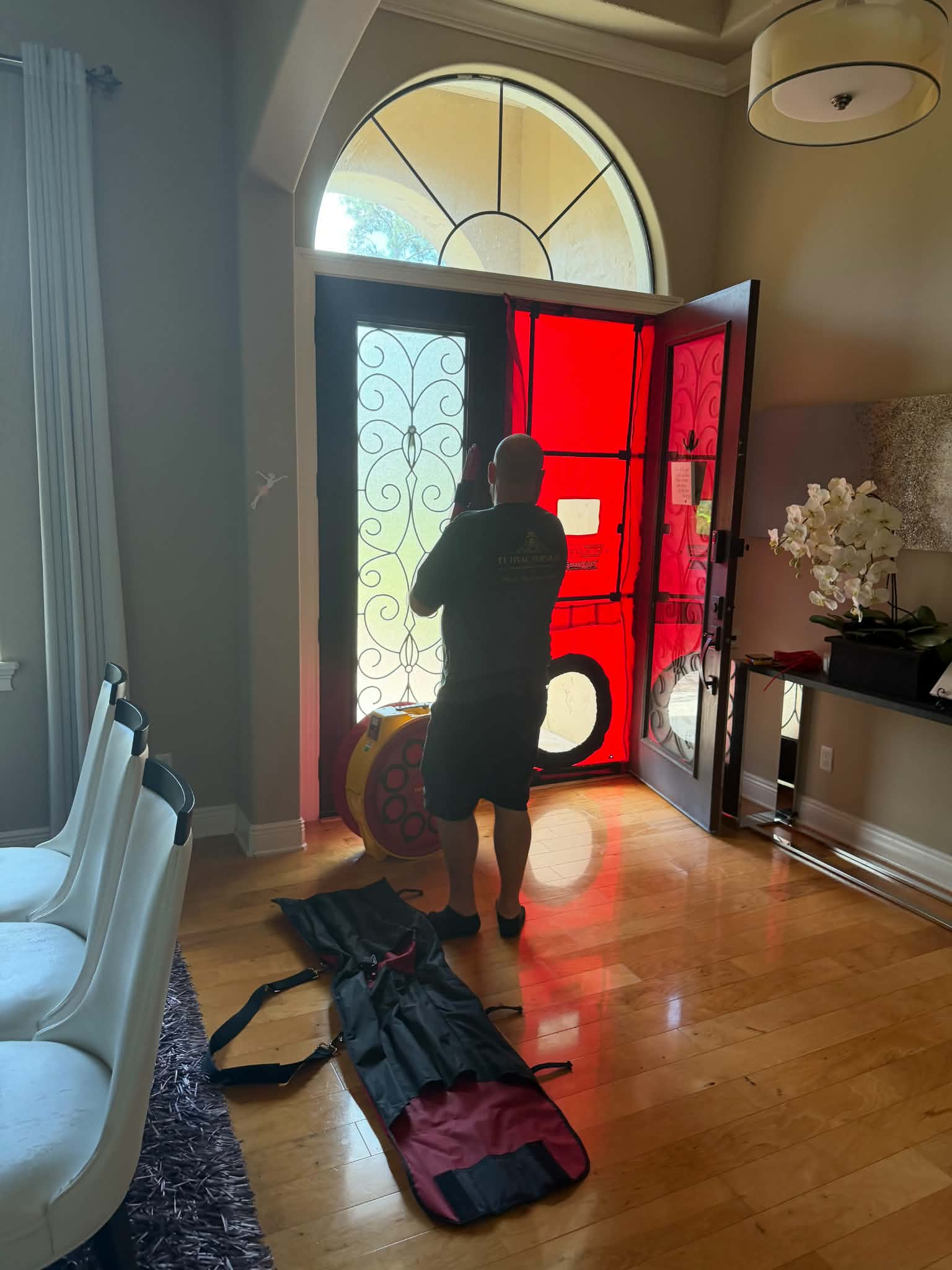
A blower door test measures how much outside air leaks into the house, one of the building numbers the design starts from.
A Manual J load calculation is the industry standard, and most people think it tells you what size AC to buy. It doesn’t. Manual J sizes the house, not the unit, at the hottest, most humid afternoon of the year. It doesn’t account for shade trees, blocked wind or a pool enclosure next to the house, and those change the real load.
Your AC also has to remove the moisture your household creates every day. Two houses the same size can need very different things:
A system chosen by square footage doesn’t know any of this. A performance evaluation does.
Cooking, showers or a full house and everything turns sticky? We’ll find why your system can’t keep up with how you live.
Your air conditioner is the only thing in your house that pulls in, conditions and sends back out all of the air, all day long. Nearly every breath your family takes inside has passed through it. So when the air in your home is bad, the AC is usually involved in one of two ways.
It creates the problem. An AC that doesn’t remove moisture correctly keeps the air handler wet and grows mold. Leaky return ducts can pull in hot, dusty attic or garage air. Air leaks in the house pull in humid outdoor air. High humidity also makes chemical pollutants like formaldehyde release faster.
It spreads the problem. New flooring, furniture, paint, cleaning products and other things in your home release chemicals into the air. Off-gassing that should stay in one space gets picked up by the AC and distributed through the entire house.
That’s why a better filter, a UV light or an air purifier doesn’t fix it. Those treat a symptom. Fixing the system fixes the air.
We measure indoor air quality with an AirAdvice monitor for particles, chemical pollutants (VOCs), formaldehyde, carbon dioxide, carbon monoxide, temperature and humidity. Then we test again after the correction to prove it worked.
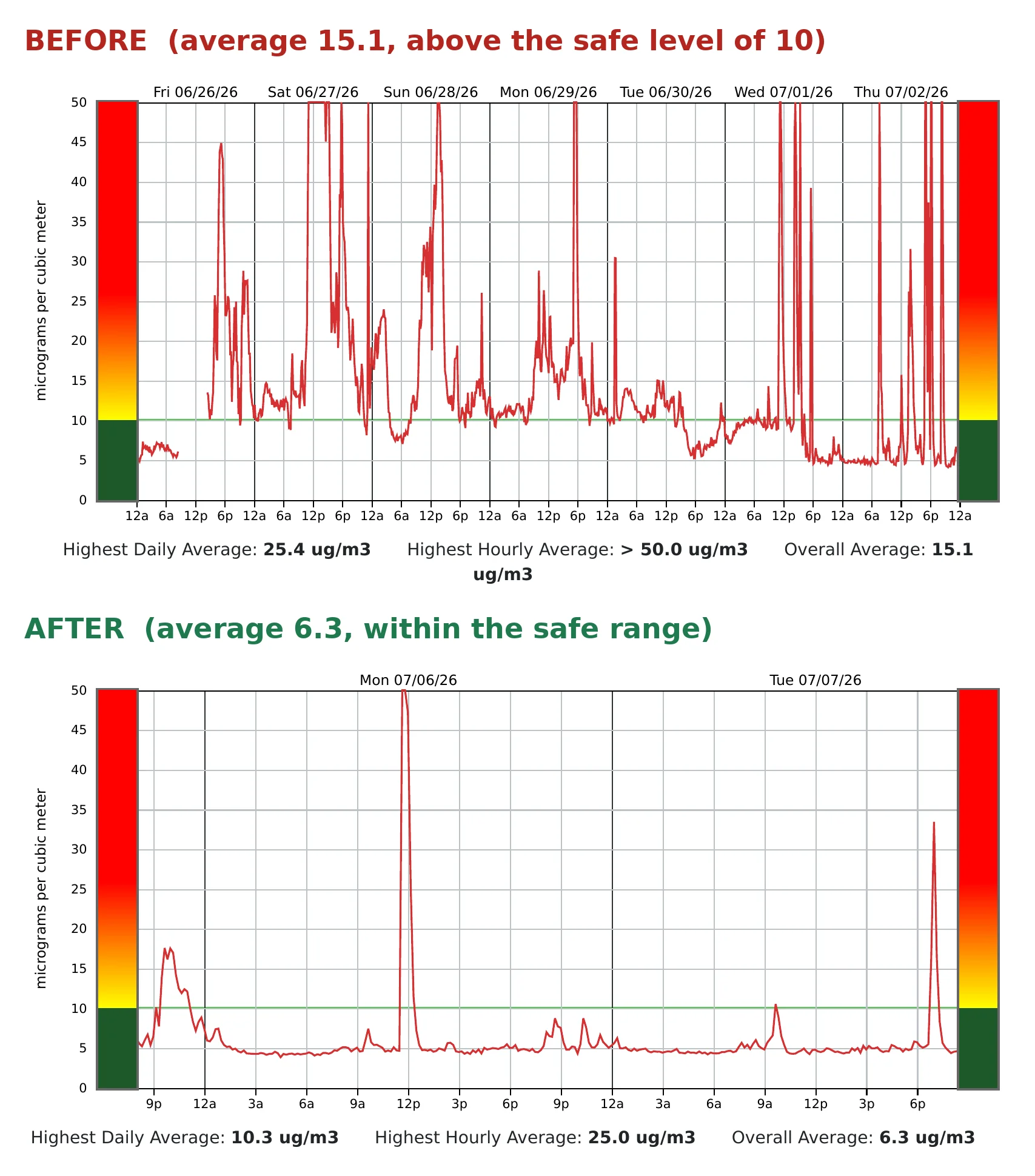
AirAdvice readings from a Central Florida home: airborne particles before and after the system was corrected.
Allergies, headaches or a musty smell that only happens at home? Call us. We’ll find out if your AC is causing it.
The resistance your system’s blower works against as air moves through the filter, coil and ductwork. Every system has a maximum the manufacturer designs it to handle. When it’s too high, the system is working against itself, and you get higher bills, worse comfort and shorter equipment life. Most service calls never measure it.
The volume of air your system moves, measured in cubic feet per minute (CFM). Your system is designed to move a specific amount of air for its size and for what your home needs. Too much or too little changes how well it cools, how well it removes moisture and how evenly each room is conditioned.
The difference between the air going into your system and the air coming out. A split of 18 to 20 degrees is considered normal. It confirms the coil is cooling. It doesn’t confirm the system is performing for your home.
Sensible cooling lowers the temperature. Latent cooling removes moisture. In Florida, the latent side decides whether your home feels comfortable or sticky. An AC can be strong on one and weak on the other.
The share of an AC’s work that goes to lowering temperature instead of removing moisture. Your home has its own ratio, and the system has to match it.
The temperature at which moisture in the air turns into water. When surfaces in your home or inside your AC reach dew point, they get wet. Wet surfaces are where mold grows.
How much heat and moisture your home takes on. Peak load is the hottest day of the year. Partial load is everything else, and it’s where your AC spends most of its life.
The industry method for calculating how much cooling a building needs at peak conditions. It sizes the house, not the unit.
How to size an AC unit →The AC turns on and off in short bursts, a classic sign of an oversized system. The house cools quickly, but the unit never runs long enough to remove the humidity.
Air leakage (blower door and duct blaster tests): a blower door test measures how much outside air leaks into your home. A duct blaster test measures how much your ductwork leaks.
Learn about the blower door test →Learn about the duct blaster test →Your thermostat only shows temperature. You feel humidity. A home at 75° and 50% humidity feels more comfortable than a home at 72° and 60%. When performance is off, you keep turning the thermostat down and never feel right.
See humidity control →A system that isn’t performing runs longer, works harder and wastes energy. We’ve redesigned systems for homeowners paying $500 a month and brought their bills down to around $100 to $150.
Watch: $870 bill with a 1-year-old AC →When an AC doesn’t remove moisture the way it should, the inside of the air handler stays dark, cold and wet. Your AC becomes a mold breeding machine and pushes that mold through your ductwork into every room. Mold in an AC is common in Florida, but it isn’t normal. A correctly designed and installed system should never grow mold in the air handler. The U.S. EPA recommends keeping indoor humidity below 60% to limit mold growth.
See mold in AC →Paying more every month for a house that still isn’t comfortable? Call us. We’ll show you where the money is going.
Indoor air quality specialists and mold inspectors can often confirm there’s a problem. The humidity is high, the air tests poorly, there’s mold. They hand you a report full of numbers and a list of products to buy.
Then the problem comes back. Testing tells you what’s in your air. It doesn’t tell you why it’s there.
The cause lives in how the AC system was selected, sized, installed and set up for that building, and correcting it takes HVAC system design.
Had a mold inspection that told you what’s growing but not why? We find why, and we fix it.
Every house and every situation tells us something different. So we don’t guess, and we don’t start with a product.
How it’s built, what surrounds it and how your family lives in it.
The full set of performance readings, not the few easy ones.
Every reading is compared to the manufacturer’s specifications for your exact equipment and to what your building needs.
The data tells us what your house is actually doing, and the design math tells us the solution.
We fix the cause, then measure again to prove it worked.
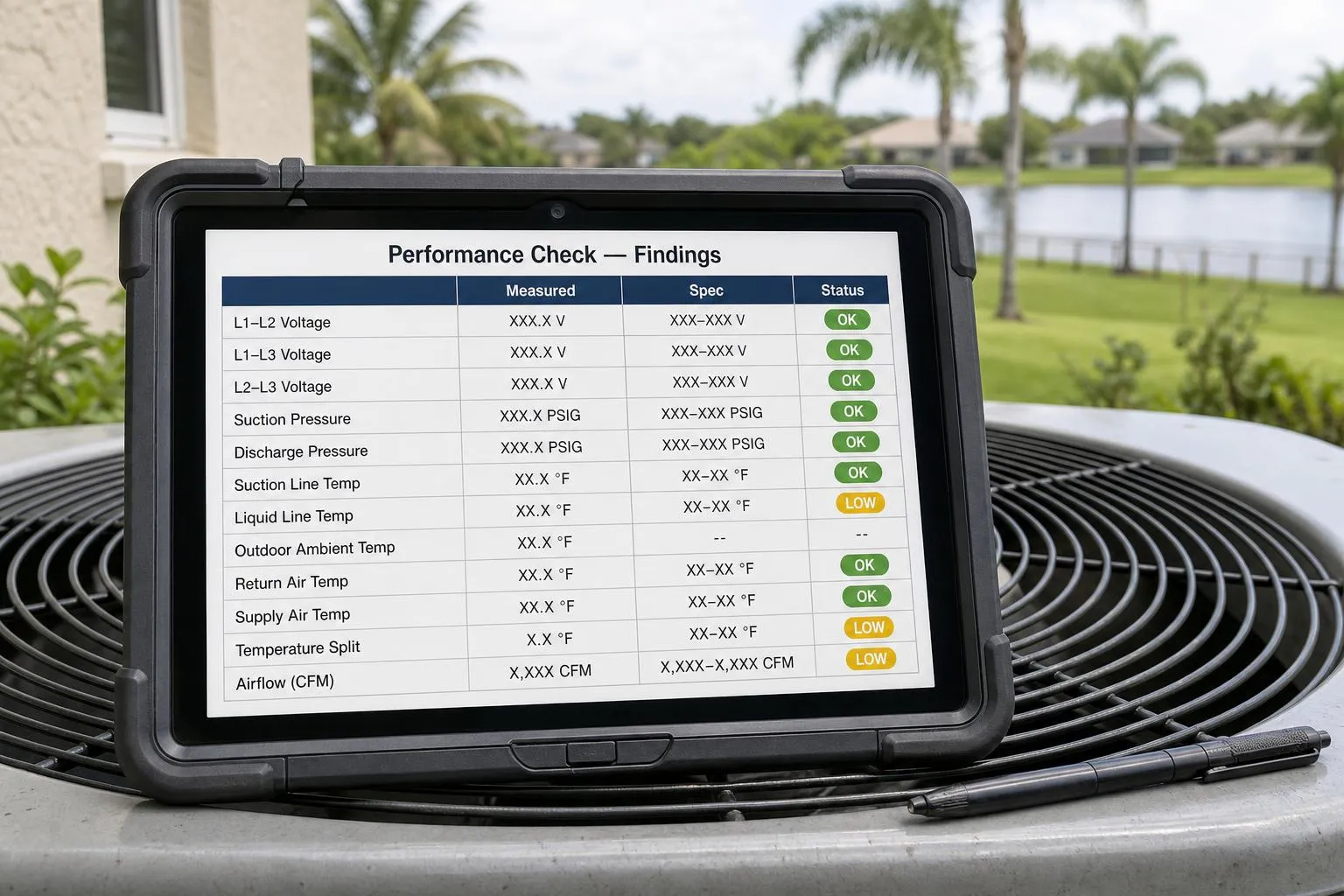
Every reading goes into written findings, compared to the manufacturer’s specifications for your exact equipment.
It starts with our AC Performance Checkup, a visit of about 2 hours with written findings. When we correct a humidity problem, we guarantee about 75° and 50–55% humidity in your home, in writing, even at the peak of summer.
A 5-ton system in a home that needed 3 tons. Uneven rooms, and one bedroom was always hot. Every room is now even, including the sunny one.
Watch Steve’s story →An enclosed lanai that never matched the rest of the house, and no way to run new ductwork. We designed around it. The lanai now matches every other room, with less equipment than before.
Watch Louisa’s story →Other contractors kept adding UV lights. We corrected the cause, and her air handler has stayed clean since.
Watch the video →Three companies came out and couldn’t find the problem. We measured and found it.
Watch the video →
Look up FL HVAC Services on Google and you’ll see a line most AC companies don’t have: “Home energy auditing recognized by the US Dept. of Energy.” Tap it and the Energy Skilled badge pops up, with a link to Energy.gov.
Nobody can add that to a business listing themselves. Not us, and not a marketing company. The U.S. Department of Energy verifies the credential and reports it to Google, and Google puts it on the listing.
What it means for your home: we look at your house and your AC as one system. How outside air leaks in, how humidity builds up, how air moves from room to room, and why some homes end up with stale, stuffy air that makes people feel worse inside than out. Then we design and fix your system for what your home actually needs.
✓ Verified by the U.S. Department of Energy
✓ Shown on our Google listing by Google itself
✓ Trained in humidity, air leaks, airflow and indoor air quality
They checked operation: whether the unit runs. Humidity is a performance problem. It depends on how the system was selected, sized, installed and set up for your building and how you live. Finding it takes an HVAC system design evaluation.
It means the coil is cooling the air. It doesn’t tell you how much moisture the system removes, how much air it moves, or whether every room gets what it needs.
It’s the resistance the blower works against as air moves through the filter, coil and ductwork. Every system has a manufacturer-rated maximum. Most service calls never measure it.
Because working isn’t performing. When an AC doesn’t remove moisture correctly, the air handler stays wet and mold grows. A correctly designed and installed system should never grow mold in the air handler.
Yes. Most indoor air quality problems are created by the HVAC system, or spread by it. The AC moves nearly all the air in your home, so it either cleans that air or spreads moisture, mold and chemical pollutants to every room.
They can identify it. The cause is usually in how the AC system was designed and installed for your building, and that takes HVAC system design to correct.
Not always. Spray foam lowers the heat load but traps humidity, so the house stays cool but damp. We test whether the existing system can remove that humidity, then determine how to balance it.
Usually not. High humidity and uneven rooms rarely come from the unit itself, and a bigger unit is often more oversized. Even an oversized system can often be corrected without replacing it.
AC technicians are trained in technical school on units and their parts. Evaluating how a building and a system perform together, and selecting the right match from about 17,000 combinations, is HVAC system design.
FL HVAC Services performs AC performance evaluations for homes across Central Florida, including Marion, Sumter, Lake, Citrus and Orange Counties.